
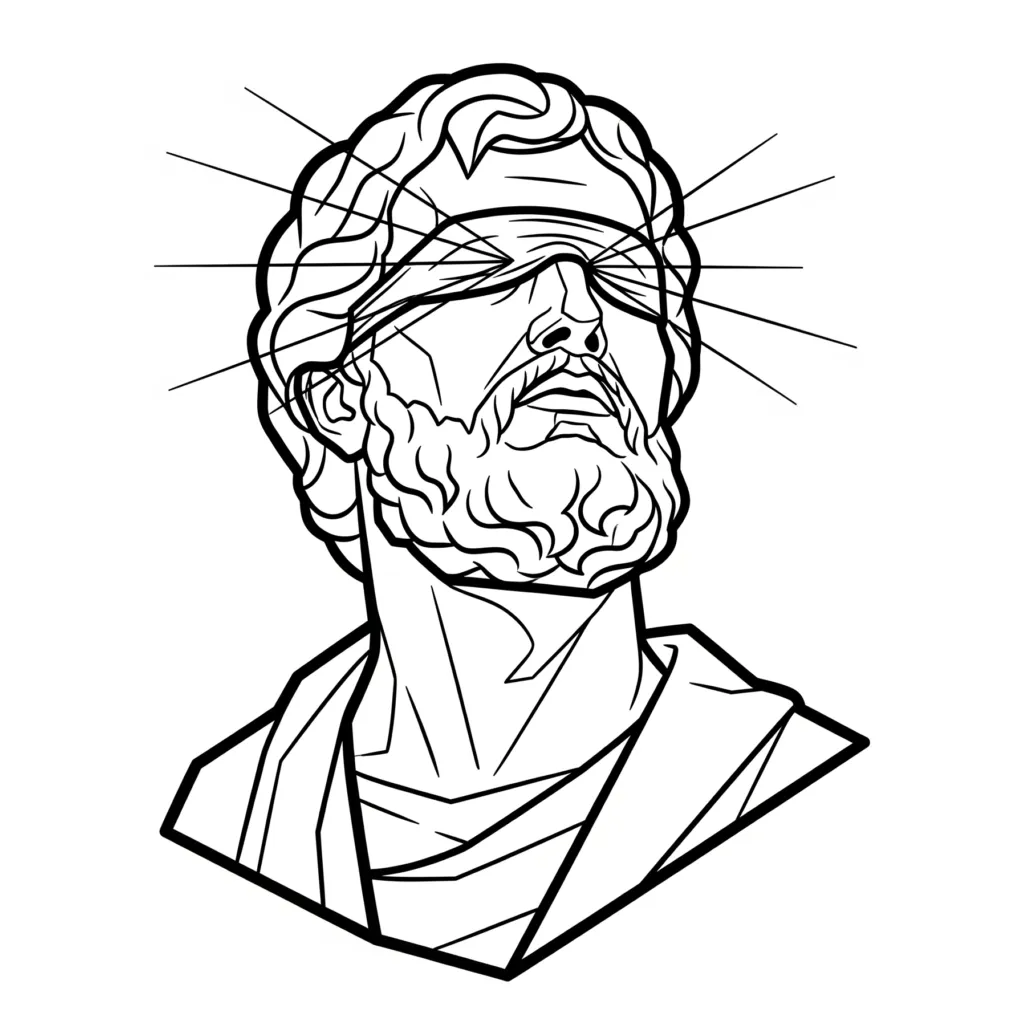
The account of Saul on the road to Damascus is one of the clearest examples of how the Bible speaks in psychological, not historical, language. When read symbolically, the story is not describing a supernatural punishment followed by a miraculous healing, but a profound inner reversal of perception.
The “scales falling from Saul’s eyes” represent the collapse of self-judgement based on appearances.
Before this moment, Saul is utterly convinced that he sees correctly — morally, spiritually, intellectually. Yet the text insists that he is blind. This contradiction is deliberate. Symbolically, Saul’s vision is dominated by judgement: right and wrong, worthy and unworthy, success and failure, saint and sinner. He measures both himself and others by external conditions and visible outcomes.
This is significant because the Bible names God in Genesis as Elohim — a plural term meaning judges or rulers. Creation itself begins through judgement, not condemnation, but through the power of definition: “let there be.” Judgement, in Scripture, is not punishment — it is the act of assigning meaning.
In Neville Goddard’s framework, Saul is operating from a state of consciousness that believes judgement comes from the world. Experience appears to deliver verdicts, and circumstances seem to rule his sense of self. But the Bible exposes this as inversion: it is Saul himself who is judging and ruling his experience through assumption.
The light on the road to Damascus
The light that stops Saul is not new information or instruction. It is revelation. It exposes the inner contradiction of his state. The very thing he believes he is defending — God, righteousness, truth — is what he is persecuting by judging.
“Why persecutest thou me?”
This question strikes at the heart of Exodus 3:14 — “I AM THAT I AM.” To judge the self through appearances is to persecute the “I AM”. It is to treat awareness as something ruled by outcomes, rather than recognising it as the ruling principle itself.
In other words, Saul is attempting to act as a servant of God while unknowingly judging and ruling against God — because God, in Scripture, is the I AM.
The meaning of the scales
When the scales fall from Saul’s eyes, something specific is removed. Scales are filters. They symbolise interpretive overlays — the habits of seeing oneself through consequence, history, morality, reaction, and comparison.
With the removal of these filters, Saul no longer reads experience as a verdict on his worth. The world ceases to function as a courtroom. Self-accusation, previously reinforced by conditions, loses its authority.
In simple terms, Saul stops judging himself by what he sees — and therefore stops misusing the creative power of judgement that Genesis assigns to Elohim.
This is the same inner movement Neville describes when a person stops asking, “Is this working?” and instead rests in assumption. Vision returns not because circumstances change, but because the ruling interpretation changes.
Why Saul becomes Paul
The name change marks the completion of this reversal. Saul, whose name carries the sense of demanding or asking, becomes Paul — meaning small or humbled. This is not humiliation, but humility of vision.
Paul no longer stands over life as judge. He stands within it as awareness.
From this point onward, the meaning of Jesus becomes clear. Jesus means Salvation — not rescue from the world, but rescue from misjudgement. I AM saves. Salvation is the release from condemning the self through appearances.
From this state, Paul’s teaching necessarily shifts. Faith replaces works. Inner conviction replaces outer law. Grace replaces condemnation. These are not theological preferences; they are the natural expressions of a consciousness no longer ruling itself against itself.
As long as the scales remain, judgement is misdirected. Only when judgement collapses back into awareness does vision return.
To “see” in the biblical sense is not to predict outcomes or control appearances, but to recognise that awareness itself is the judge, the ruler, and the source from which all meaning flows.